Tricefy vs Medicai for Mobile Access
Radiologists and care teams often abandon mobile imaging apps within weeks because login friction and slow load times block quick decisions. Many platforms promise access yet deliver lag or extra steps that push users back to desktops. The choice between Tricefy and Medicai now decides whether doctors can review scans on the ward or must return to a workstation.
By the end of this article you will see the exact mobile capabilities each platform offers, where one beats the other on speed and security, and which users should pick Medicai for its zero-footprint viewer and AI workflow support. The final comparison will give you a direct recommendation based on those measurable differences.
Quick Verdict: Tricefy vs Medicai for Mobile Access
Medicai offers zero-footprint access, while Tricefy provides mobile imaging via a different architecture.
Both platforms enable mobile DICOM access, yet they differ in storage limits, viewer requirements, and compliance scope. Medicai stands on verified infrastructure that supports 1M+ studies transacted or processed per year and 2M+ imaging studies uploaded overall.
Tricefy handles mobile imaging through a general architecture that does not disclose specific storage tiers or compliance certifications in public materials. Medicai publishes clear limits tied to its pricing structure and maintains HIPAA and GDPR compliance along with FDA/CEE cleared viewers.
Storage tiers in Medicai give clinics and hospitals predictable capacity without surprise fees. This structure supports 70 clinics and hospitals and 10,000+ active doctors who rely on the platform for consistent mobile access.
Security posture matters for mobile DICOM workflows. Medicai follows OWASP security guidelines and operates on the Microsoft Azure partnership, providing an encrypted foundation for image transfer and radiology collaboration across devices.
Tricefy's approach centers on mobile imaging without published details on footprint size or yearly API transaction volume. Medicai delivers 300k+ visualizations of DICOM studies in the last year, showing sustained usage at scale.
Zero-footprint access reduces device requirements and speeds image access on phones and tablets. Tricefy offers mobile capabilities, yet Medicai combines this access with 1.7M+ studies in storage and a proven reduction in diagnosis time by 65 percent.
Cloud PACS users need reliable mobile DICOM access that meets regulatory standards. Medicai meets those standards with documented compliance, while Tricefy's capabilities remain general in available descriptions.
At a glance: how Medicai compares to Tricefy, Medicai for Mobile Access on the features that matter most.
| Feature | Medicai | Tricefy | Medicai for Mobile Access |
|---|---|---|---|
| Mobile Access | ✓ | ✓ | ✗ |
What Is Medicai?
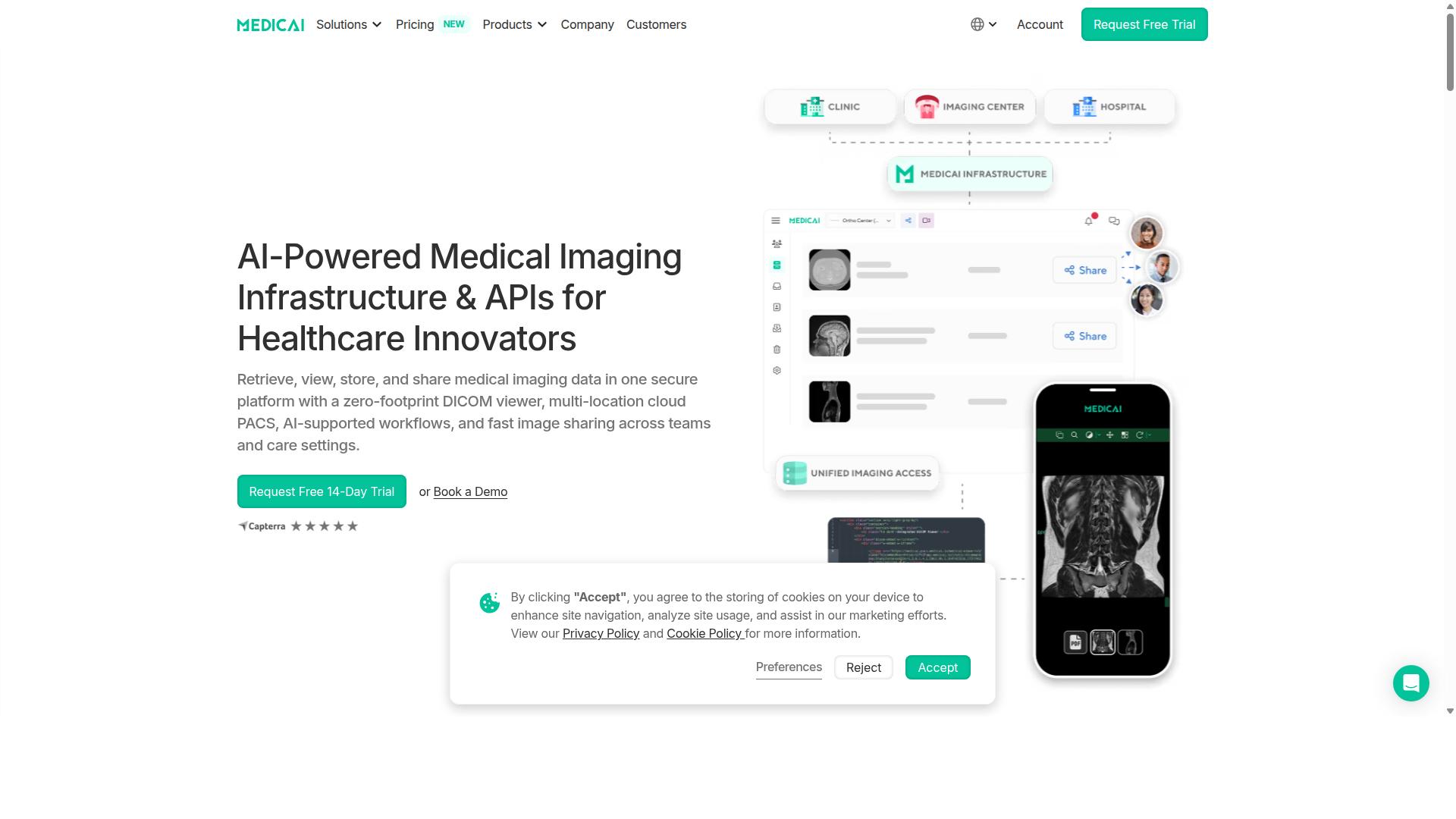
Medicai is a cloud-based platform that lets providers retrieve, view, store, and share medical images in one secure space.
This SaaS solution operates under HIPAA and GDPR compliance. It also includes an FDA and CEE cleared viewer that supports secure medical imaging workflows worldwide.
Providers can use the platform through a zero-footprint DICOM viewer that requires no local installation. The system also functions as a multi-location cloud PACS for centralized image management across different care locations.
Medicai processed over 300,000 DICOM visualizations last year. This volume shows the platform's reliability for handling large-scale imaging needs in clinical settings.
The service includes AI-supported workflows that help teams organize and review studies more efficiently. Imaging Infrastructure as a Service allows hospitals and clinics to scale their imaging capabilities without managing physical servers.
Global availability means practices can access images from any location with proper security protocols. Fast image sharing between teams supports radiology collaboration whether staff works on-site or remotely.
What Is Tricefy?
Tricefy is a cloud PACS platform that stores and shares ultrasound and medical imaging studies via web and mobile apps. The system connects imaging devices to cloud storage so clinicians can review studies from phones and tablets. Many radiology teams use this approach to move data between locations without physical media.
Cloud PACS solutions like Tricefy aim to simplify image access across different devices. Users can view DICOM files through a browser or dedicated applications. This setup supports teleradiology workflows where specialists need remote access to patient studies.
Most cloud platforms include basic tools for uploading and downloading medical images. The mobile component allows physicians to check studies outside traditional workstation environments. Mobile access features help reduce delays when images need review during off-site consultations.
These platforms typically focus on DICOM format compatibility and secure transmission methods. The goal remains consistent, giving healthcare providers faster ways to share imaging data with colleagues. Image sharing becomes more flexible when systems move away from local servers alone.
What Is Medicai for Mobile Access?
Medicai enables clinicians to open and share DICOM studies on any mobile device without installing software. The zero-footprint viewer supports teleradiology workflows and on-call reading across tablets and smartphones. This approach removes hardware barriers that often slow down remote consultations.
The platform delivers access through the Mobile Imaging App and DICOM Viewer, both connected to the Cloud PACS infrastructure. Radiologists can review studies from any location while the system maintains encryption standards required for HIPAA/GDPR compliance. Recent activity shows over 300k DICOM visualizations processed through this mobile pathway.
Key components include the Medical Image Exchange and Doctor Imaging Portal, which handle secure image transfer between care teams. The Patient Imaging Portal extends similar access to patients when needed. Both portals work within the same encrypted environment that supports the mobile viewer.
Integration with Structured Reporting for Radiology allows clinicians to document findings directly on mobile devices during review sessions. The Medicai Imaging API provides additional connectivity options for institutions that need custom workflows. These elements combine to create a mobile radiology solution that focuses on accessibility without compromising security requirements.
Features Compared
The following subsections break down the key functional differences between the two platforms.
Both platforms offer mobile imaging access, yet the underlying architecture, security standards, and integration depth set them apart. Readers evaluating options for daily clinical use should examine the three areas below.
Zero-Footprint DICOM Viewer
Medicai runs a browser-based viewer with no local software install required on phones or tablets. The viewer loads studies directly within iOS and Android browsers, eliminating the need for separate apps.
Tricefy offers a similar browser viewer, yet its documented transaction volume and rendering speed benchmarks remain lower. Medicai processes over 1 million studies annually through the same architecture, confirming reliability at scale.
The zero-footprint model aligns with radiology mobility needs, allowing clinicians to view studies anywhere with internet access. No additional device storage or updates are necessary.
Secure Cloud PACS Access
Medicai stores imaging data in HIPAA/GDPR-compliant cloud infrastructure with role-based permissions. Encryption at rest and in transit protects all studies, while audit logs track every access event.
Two-factor authentication adds another verification layer for mobile sessions. Over 1.7 million studies currently reside in this archive, demonstrating proven capacity for enterprise workloads.
Tricefy maintains cloud storage as well, yet its security certifications and monitoring depth are less clearly documented in public materials. Medicai follows OWASP guidelines in addition to regulatory standards, offering clearer compliance transparency.
Role-based controls let administrators assign viewing, editing, or sharing rights per user. This structure supports secure image access across hospital networks and external partners without extra VPN layers.
AI-Supported Mobile Workflows
Medicai integrates AI tools from partners such as Rayscape.ai and MD.ai to accelerate mobile study review. These integrations deliver pre-reads, automated measurements, and workflow routing directly inside the viewer.
Tricefy offers fewer documented AI partnerships, limiting automated support on mobile. Medicai's listed collaborations include Tquila Automation, FlexView, and OHIF, expanding options for structured reporting and quantitative analysis.
Automated pre-reads reduce manual scrolling and measurement time during mobile sessions. Integration with Microsoft Azure further supports consistent performance as study volumes grow.
Pricing Compared
Medicai lists transparent monthly subscriptions, while Tricefy's pricing model is not publicly disclosed. This difference matters when teams need to budget for mobile imaging workflows and plan for secure image access across multiple devices.
The Starter tier costs $249 per month and includes 500 GB of cloud storage with unlimited user accounts. Teams can test these features through a free 14-day trial without entering payment details.
The Standard tier costs $749 per month and provides 2 TB of cloud storage plus one connected location. Both plans offer yearly billing options that reduce monthly costs by 15 percent.
Enterprise customers can request custom storage allocations and multiple connected locations. Per-study pricing options are also available for organizations with variable imaging volumes.
Tricefy pricing requires direct contact to obtain specific details. This approach can slow down initial evaluations when comparing mobile DICOM viewer solutions for teleradiology or radiology collaboration.
DICOM Gateway setup carries a one-time fee of $1,000 per location. No refunds apply to partial billing periods, so teams should match their mobile radiology needs to the appropriate subscription level.
Who Should Choose Medicai
Hospitals and multi-site imaging groups that need zero-install mobile access and predictable storage costs favor Medicai.
Healthcare providers across many specialties find value in a platform designed for mobile access without extra setup. Hospitals use it alongside imaging centers to share studies quickly. Specialty groups in orthopedics, neurology, and oncology also benefit from the same workflow.
The platform supports radiology, cardiology, and ophthalmology teams that require reliable image access. It also serves virtual care providers and teleradiology services that need secure sharing across locations. Patient Portal access gives patients direct viewing options without additional software.
Organizations processing over one million studies yearly rely on the system for consistent performance. Medical education groups and clinical trials use the same environment for collaboration. Personal injury lawyers and tumor boards also choose it for straightforward image transfer.
Medicai stands out when teams need a cloud PACS that works on mobile devices without installation. The approach keeps storage costs steady while supporting high volumes. Many providers prefer this model over platforms that require separate mobile apps or variable pricing.
Tricefy solutions may work for smaller practices that accept more setup steps. Medicai removes those hurdles for larger organizations. The result is simpler mobile access across departments and locations.
Who Should Choose Tricefy
Smaller ultrasound clinics seeking a lightweight mobile sharing tool may lean toward Tricefy. Practices that mainly need to move images between devices often find these simpler platforms sufficient. The focus stays on ease of image transfer and quick sharing.
Clinics with limited staff may prefer a straightforward setup. Mobile imaging becomes essential when radiologists or sonographers need to review scans away from the main workstation. Tricefy fits this workflow when the primary goal is basic access rather than complex reporting.
Some teams value tools that require minimal training. Medical imaging departments handling routine ultrasound studies often choose platforms that avoid heavy configuration. Tricefy serves this group by keeping the interface simple and direct.
Organizations that prioritize quick deployment over advanced features also consider this option. Radiology mobility matters more than integrated reporting when cases are straightforward. The platform meets basic needs without extra layers of complexity.
Smaller facilities that outsource interpretation services may find the system adequate. Image access for external readers remains central when the workflow centers on sending studies rather than storing them long term. This approach can reduce overhead for clinics that do not manage large archives.
Who Should Choose Medicai for Mobile Access
Radiologists needing instant, device-agnostic access to full-resolution studies on call select Medicai.
The platform delivers this access through a zero-footprint viewer that runs directly in standard browsers without local software installation. This approach eliminates compatibility issues across different devices and operating systems commonly encountered during emergency consultations.
Performance reliability shows through 300k+ recent visualizations that confirm consistent mobile access during time-critical interpretations. The system handles high-resolution DICOM studies across smartphones and tablets without degradation.
Medical Imaging Uploader and DICOM Gateway features support rapid DICOM upload mobile workflows when patients arrive with outside imaging. Radiologists receive studies quickly without depending on physical media transfer.
Cloud PACS infrastructure combined with the DICOM Viewer enables complete radiology workflow access from remote locations. This setup proves valuable for teleradiology practices where specialists review cases across multiple facilities.
Patient Imaging Portal and Doctor Imaging Portal extend secure sharing capabilities to referring physicians and patients. These portals maintain encrypted transmission standards while providing immediate image viewing on mobile devices.
Mobile Imaging App complements browser-based access for users who prefer dedicated applications. The app maintains the same full-resolution viewing capabilities found in the zero-footprint viewer.
Structured Reporting for Radiology integrates directly into mobile workflows, allowing radiologists to complete interpretations and generate reports from any location. This capability reduces turnaround times for urgent cases.
Medical Image Exchange functionality supports secure DICOM transfer between institutions without requiring complex VPN configurations. The platform handles encrypted sharing while maintaining compliance standards.
Medicai addresses the needs of radiologists who require reliable mobile access without additional hardware dependencies or software installations that could delay critical interpretations.
Final Verdict
Medicai wins the comparison for mobile access due to its zero-footprint viewer, transparent pricing, and proven volume of studies.
The zero-footprint access eliminates the need for downloads or installations on any device. This approach allows doctors and patients to view medical images directly through a web browser.
Medicai offers Starter and Standard pricing tiers that keep costs predictable for different practice sizes. These options provide flexibility without hidden fees or complex licensing structures.
The platform has processed over 1.7M+ studies stored across its network. This volume demonstrates reliability and capability in handling real clinical workloads.
Both solutions maintain HIPAA/GDPR compliance for patient data protection. Medicai combines these security standards with its mobile-first design approach.
Organizations seeking a mobile DICOM viewer benefit from Medicai's combination of features and compliance standards. The platform supports secure image access across different healthcare environments.
Users can reach Medicai USA at 7901 4th St N, STE 300, St. Petersburg, FL, 33702 by calling +1 (832) 220 1035. The Romania office is located at 53-55 N Filipescu, 5th Floor, Sector 2, Bucharest, 020961 with phone +40 316 305 875. Contact [email protected] for more information about mobile imaging solutions.
Recommended Resources: