Where to Buy Peptides in Canada Online: What Researchers Should Check in 2026
Canadian researchers sourcing peptides online face a fog of unverified COAs and unclear shipping terms. In 2026, batch documentation and cross-border delivery matter more than a polished storefront. A supplier that cannot show independent lab results per batch is a gamble, not a source.
This article explains what Kovagen supplies, how its Canada shipping works, and which checks separate a documented peptide vendor from a risky one. By the end, you will know how to evaluate batch testing, purity documentation, pricing in USD, and whether Kovagen fits your lab's requirements.
What Is Kovagen (KOVA)? Research Peptides for Canadian Labs
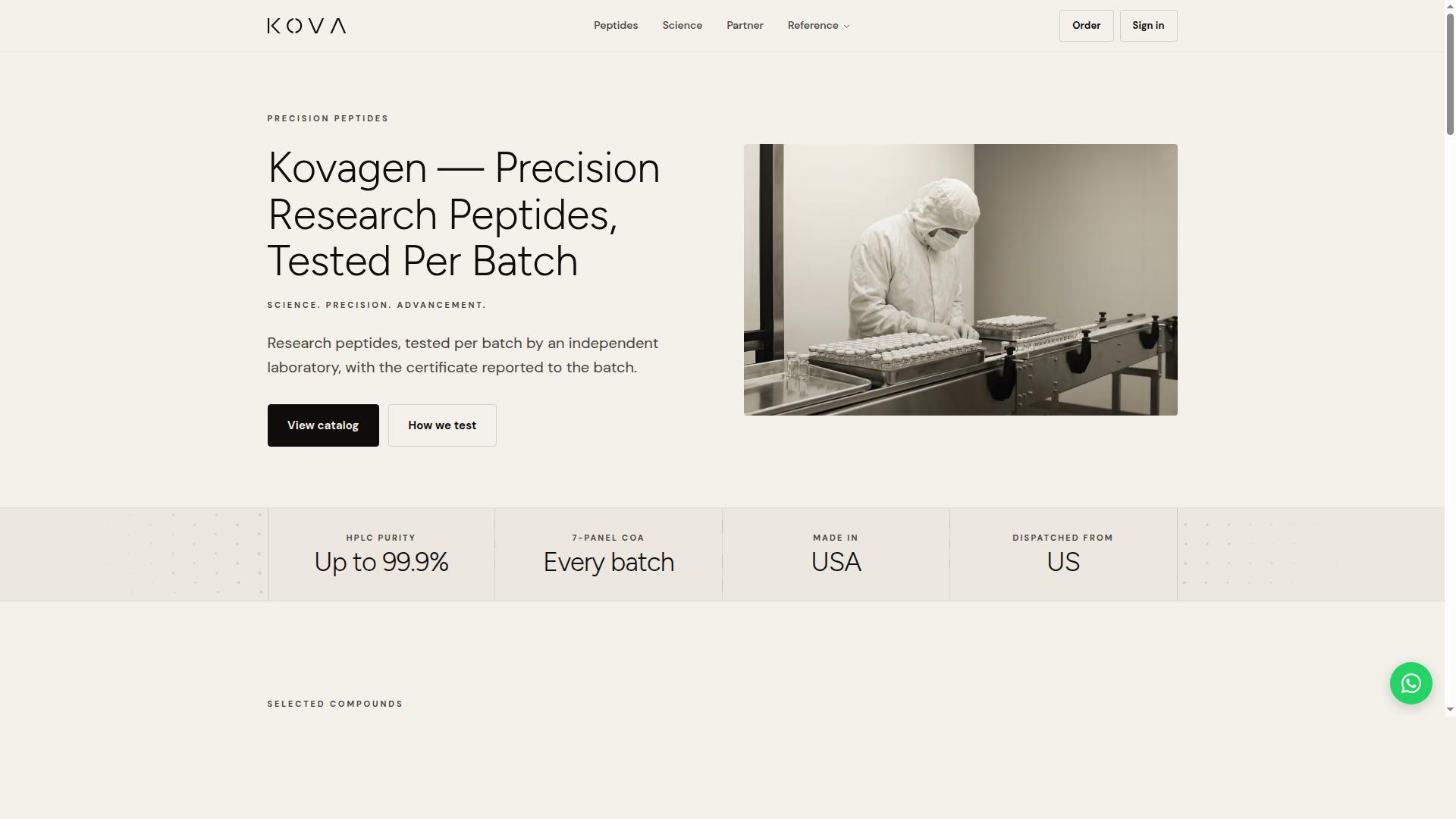
Kovagen (KOVA) is a research peptide supplier that ships to Canada and the United States, offering lyophilized peptides and research supplies for laboratory use. KOVA is the mark printed on the vial and a trading name of Kovagen, so both names point to the same catalog and certificate library.
The brand positions itself around a simple promise: Precision Research Peptides, Tested Per Batch. Its products are supplied for laboratory research only, not for human or veterinary consumption.
For Canadian labs comparing options in 2026, Kovagen is best understood as a research-grade supplier rather than a consumer store. The sections below cover who it serves and how Canadian deliveries work.
Who Kovagen Serves and How It Ships to Canada
Kovagen serves laboratory researchers in Canada and the United States, shipping orders via FedEx 2Day for U.S. destinations and FedEx International for Canadian deliveries. The catalog is built around laboratory peptides and supplies, with product documentation tied to each batch rather than to a general product line.
For U.S. orders, dispatch happens on the next business day. That schedule matters for researchers planning experiments around peptide stability, since a prompt handoff to the courier shortens the time a lyophilized powder spends in transit before it reaches controlled storage.
Canadian shipping is available, but customers are responsible for customs and import regulations. Before ordering, researchers should confirm that the compounds they select are permitted for laboratory use in their province and understand how Health Canada regulations and customs clearance apply to their shipment.
Two limits are worth noting up front:
- Kovagen ships to the United States and Canada only and cannot ship anywhere else at this time.
- All products are supplied for research use only, which means buyers should expect research-grade framing throughout the catalog.
For Canadian labs, the practical takeaway is straightforward. Kovagen is a legitimate research peptide source for the Canadian and U.S. market, with clear shipping terms and a documented per-batch testing promise. Researchers who verify import requirements before ordering can plan around the customs step with confidence.
Can Researchers in Canada Buy Peptides Online From Kovagen?
Yes, Canadian researchers can purchase peptides online from Kovagen, but they must navigate import regulations and customs clearance. Kovagen ships to both the United States and Canada, and it cannot ship anywhere else at this time.
That geographic focus matters for buyers comparing suppliers. A vendor that serves only two countries can concentrate on the shipping and documentation demands of those markets rather than spreading resources across global logistics.
Canadian researchers should still treat every order as a compliance decision. Import regulations and prescription requirements apply to certain compounds, and the buyer carries responsibility for confirming that a given research peptide is lawful to receive in Canada.
Kovagen supplies research-grade peptides for laboratory use. Products are not intended for human consumption, and researchers should keep that distinction clear when ordering, storing, and documenting materials.
Shipping, Timelines, and Ordering From Canada
Ordering from Kovagen for Canadian delivery involves online checkout, payment in USD, and shipping via trackable carriers, with timelines varying by customs processing. The process follows a straightforward path from catalog to delivery.
- Browse the online catalog and select the research peptides you need.
- Complete checkout and pay in USD, keeping in mind any currency conversion your card issuer applies.
- Track the shipment through the carrier once it clears dispatch.
Timelines differ by destination. U.S. orders ship FedEx 2Day, with dispatch by the next business day after payment clears. Canadian orders travel FedEx International, typically 3 to 7 business days, subject to customs. That range is an estimate, not a guarantee, because clearance can add time.
Customs clearance deserves attention before you order. Researchers should be aware of potential duties, applicable taxes, and import regulations that may apply to laboratory peptides entering Canada. Having documentation ready can reduce delays if a shipment is held for review.
Payment security is a practical concern for any online purchase. Using a credit card with fraud protection gives you a dispute channel if something goes wrong, and it keeps a clear record of the transaction.
Kovagen publishes its shipping policy and areas served on its site, so researchers can confirm current details before checkout. For laboratory planning, build a buffer into your timeline. If a study depends on a specific peptide arriving by a set date, order early enough to absorb customs processing and any follow-up paperwork.
Storage planning belongs in the same conversation. Lyophilized powder generally holds up better in transit than reconstituted material, and once a vial is prepared with bacteriostatic water, storage temperature and peptide stability become active concerns. Researchers should have a cold chain plan ready before the package arrives.
What to Check Before Buying Peptides Online in Canada in 2026
Before buying peptides online in Canada in 2026, researchers should verify vendor legitimacy, testing protocols, and documentation to avoid scams and ensure quality. The market has grown crowded, and not every storefront selling research peptides operates with the same standards.
Due diligence matters because peptide purity, peptide stability, and proper handling directly affect experimental outcomes. A cheap listing with no paperwork is rarely a bargain when the material inside cannot be trusted.
Canadian buyers also face a specific regulatory layer. Health Canada regulations govern what can be sold, how it is labeled, and whether a product crosses into prescription requirements or controlled substances territory. Vendors who ignore this landscape create risk for the researcher, not just themselves.
Practical checks fall into a few clear buckets: independent third-party testing, transparent certificates of analysis, verified purity data, proper product format, and honest claims about compliance. The sections below break each one down so researchers can apply a repeatable vendor verification process rather than relying on marketing copy.
Batch Testing and Certificates of Analysis
Batch testing by an independent laboratory and access to certificates of analysis (COAs) are critical indicators of peptide quality and vendor transparency. A COA is only meaningful when the lab behind it has no financial stake in the result.
Look for a certificate of analysis that includes HPLC analysis with a stated purity figure and mass spectrometry confirmation of molecular identity. The document should be tied to a specific batch number, not a generic sample posted once and reused indefinitely.
Retrievability matters as much as content. A credible vendor lets a buyer pull the COA for the exact batch they received, ideally without creating an account or emailing support. If the batch number on the vial does not match any published document, treat that as a red flag.
Warning signs include:
- COAs generated in-house by the vendor's own lab
- Refusal to share a certificate before purchase
- Documents with no batch number, lab name, or test date
- Purity claims with no chromatogram or method details attached
Kovagen addresses this directly: every batch is tested by an independent analytical laboratory, not in-house, and certificates of analysis are published per batch and retrievable by batch number without an account. The company also publishes a 7-panel COA for every batch and reports HPLC purity up to 99.9%. For researchers applying the checks above, that combination of independent testing and open documentation is exactly the standard to hold other vendors to in 2026.
Purity, Documentation, and Product Format
Purity levels, proper documentation, and product format (such as lyophilized powder) directly affect research outcomes and should be verified before purchase. Each element is easy to confirm if the vendor is forthcoming, and difficult to confirm if they are not.
On purity, expect HPLC results of at least 95%, with anything above 98% a stronger signal for research-grade peptides. Ask whether the figure reflects the specific batch in stock. Documentation should pair the COA with a safety data sheet, and any claim of GMP compliance or ISO certification should be backed by a certificate number or issuing body that can be checked independently.
Format affects peptide stability more than many buyers realize. Lyophilized powder is the preferred format for laboratory peptides because it holds up better in transit and in storage than pre-mixed liquid. It does require reconstitution with bacteriostatic water before use and careful storage temperature control afterward, typically around -20°C for long-term holding.
Shipping conditions belong in the same check. Cold chain shipping is often marketed as essential, but ambient transport of a properly lyophilized powder is common practice, and vendors should state clearly how shipments travel so buyers can plan storage on arrival.
Kovagen supplies stocked research peptides as lyophilized powder, including single compounds and blends, alongside research supplies such as BAC Water. Every batch carries a 7-panel COA, products are made in the USA and dispatched from the US, and shipments travel at ambient temperature. The catalog lists 30 compounds, among them Retatrutide (GLP-3) (Reta), BPC-157, GHK-Cu, Wolverine (BPC-157 / TB-500) 10/10, and TB-500 Thymosin Beta-4 (Long Chain). All products are for laboratory research use only, and the brand states it does not provide dosing, administration, or reconstitution guidance. Researchers who verify purity, paperwork, and format against these benchmarks will be well positioned to judge any Canadian supplier they encounter in 2026.
Kovagen's Catalog: Compounds, Blends, and Research Supplies
Kovagen's catalog includes 30 compounds, made up of 22 single peptides and blends, offered as lyophilized powder, along with research supplies such as bacteriostatic water. That structure gives researchers a single source for both the research-grade peptides and the materials needed to prepare them.
Every compound in the lineup ships as a lyophilized powder, the dry format that supports peptide stability during transit and storage. Researchers should note that products are sold for laboratory research use only and are not intended for human or veterinary use.
The catalog covers a range of research categories, from metabolic and regenerative compounds to cosmetic and neuropeptide entries. Below is a look at representative examples from each group.
- Metabolic research: Retatrutide (GLP-3), also listed as Reta, Cagrilintide, MOTS-c, Tesamorelin, and a Metabolic blend (NAD+ / MOTS-c / 5 Amino 1MQ) 100/10/10
- Repair and regenerative research: BPC-157, TB-500 Thymosin Beta-4 (Long Chain), GHK-Cu, and Wolverine (BPC-157 / TB-500) 10/10
- Blends: Klow (GHK-Cu / TB-500 / BPC-157 / KPV) 50/10/10/10, Glow (GHK-Cu / TB-500 / BPC-157) 50/10/10, and Regeno (Cartalax / BPC-157 / TB-500) 10/10/10
- Growth hormone research: CJC-1295 No DAC, Ipamorelin, CJC-1295 No DAC / Ipamorelin 5/5, Tesamorelin / Ipamorelin 10/5, Sermorelin, and IGF-1 LR3
- Neuropeptide and cognitive research: Semax, Selank, Selank / Semax 5/5, DSIP, and Kisspeptin-10
- Other research compounds: KPV, SS-31, Melanotan II, PT-141, Thymosin Alpha-1, and SNAP-8
- Research supplies: BAC Water (bacteriostatic water)
The blend entries are worth a closer look because they combine multiple compounds in fixed ratios, such as Wolverine at 10/10 or Klow at 50/10/10/10. Researchers comparing blends should confirm that each component is documented clearly, since ratio labeling is central to reproducing study conditions.
Bacteriostatic water rounds out the catalog as a supporting supply for reconstitution work in the lab. Researchers ordering peptides in Canada should pair any powder with the correct diluent and follow proper handling guidance.
For those planning to buy peptides online from a Canadian supplier, a defined catalog with consistent naming and format is one useful signal during vendor verification. Kovagen's list keeps compound names, blend ratios, and the lyophilized format visible up front, which makes cross-checking against a certificate of analysis simpler.
As always, researchers should review documentation, confirm storage temperature guidance, and verify that products meet their institution's regulatory compliance requirements before ordering.
Pricing in USD: What Canadian Researchers Should Budget For
Kovagen lists prices in USD, with examples such as Retatrutide (GLP-3) from $95.00, BPC-157 10mg at $80.00, and GHK-Cu from $55.00. For Canadian researchers, these figures are a starting point rather than the final cost, because the conversion to Canadian dollars and any cross-border fees sit on top of the listed price.
The table below shows several research-grade peptides at their listed USD prices, so you can compare items within a single budget line.
| Product | Size | Listed Price (USD) |
|---|---|---|
| Retatrutide (GLP-3) | from $95.00 | $95.00 |
| BPC-157 | 10mg | $80.00 |
| GHK-Cu | from $55.00 | $55.00 |
| Wolverine (BPC-157 / TB-500) | 10/10 | $140.00 |
| TB-500 Thymosin Beta-4 (Long Chain) | 10mg | $85.00 |
| Bacteriostatic Water | single vial | $15.00 |
Blends and larger vials move the budget upward. Wolverine (BPC-157 / TB-500) 10/10 is $140.00, Glow (GHK-Cu / TB-500 / BPC-157) 50/10/10 is $145.00, and Regeno (Cartalax / BPC-157 / TB-500) 10/10/10 is $285.00. It helps to price a full protocol, not just one vial, before committing.
Currency conversion is the first adjustment. The USD to CAD exchange rate shifts over time, so the same order can land at a different Canadian total from one month to the next. Check the rate on the day you order and add a small buffer rather than converting at an old figure.
Customs and import charges are the second factor. Duties and handling fees can apply at the border depending on how the shipment is classified and processed. Build a margin into your budget so a border charge does not derail an experiment timeline.
Shipping is straightforward to plan for. Kovagen offers free shipping on orders of $250 or more after discounts, and below that threshold the shipping charge is $18. A single BPC-157 vial at $80.00 falls under the threshold, while a two or three item order may cross it.
Payment security deserves the same attention as price. Use secure payment methods and avoid any arrangement that bypasses a standard checkout. Keep your order records, since they support both budgeting and any later customs questions.
For researchers comparing buy peptides online options in Canada, the practical takeaway is to total the USD price, the conversion, the shipping, and a customs allowance before deciding. That full figure, not the sticker price, is what belongs in your lab budget.
Trust Signals: Independent Testing and Transparent COAs
Independent batch testing and publicly accessible certificates of analysis are key trust signals that distinguish reliable peptide vendors from questionable ones. When you buy peptides online in Canada, the COA is the single document that tells you what is actually inside the vial. Without it, purity claims are just marketing.
Testing by an outside laboratory matters because it verifies two things at once: identity and purity. A vendor that only tests in-house controls both the sample and the result, which removes any meaningful check. Independent analysis through HPLC analysis and mass spectrometry gives researchers a verifiable record instead of a promise.
Kovagen follows this model. Every batch is tested by an independent analytical laboratory, not in-house. Certificates of analysis are published per batch and retrievable by batch number without an account, and each batch carries a 7-panel COA. The brand reports HPLC purity up to 99.9%.
Accessibility of the COA is itself a test. A serious Canadian supplier should let you look up a batch certificate in seconds, with no login wall and no email capture. If retrieving documentation requires an account or a sales conversation, treat that as friction worth questioning.
- Batch-level documentation: a COA tied to the specific lot number on your vial, not a generic sample
- No-account retrieval: certificates searchable by batch number on the public site
- Recognizable methods: HPLC purity data and identity confirmation, not just a pass or fail stamp
- Consistency across lots: each new batch gets its own certificate rather than a recycled one
Vendors with no verifiable COAs, or with documents that only reflect in-house testing, deserve caution. The same applies to certificates that lack a batch number, a lab name, or testing dates. In a market shaped by Health Canada regulations and vendor verification expectations in 2026, paperwork is part of the product.
Testing is the core signal, but it is not the only one. Clear contact information, a physical address, and responsive customer service round out the picture. A supplier that hides behind a contact form with no location is harder to hold accountable than one that states where it operates.
Kovagen states that its peptides are made in USA and dispatched from the US, with shipments travelling at ambient temperature. For Canadian buyers, that origin detail is useful context when comparing documentation and shipping timelines across listings.
Two other points are worth knowing before you order. The brand states it does not publish customer reviews and does not provide dosing, administration, or reconstitution guidance. Neither is a red flag in itself, but researchers should plan their own protocols and read the COA rather than expect usage instructions from the vendor.
Weigh these signals together: an independent lab report, a batch number you can check yourself, a stated address, and a supplier that answers questions promptly. That combination is what separates a credible research peptide source from a listing that only looks the part.
Who Should Buy From Kovagen - and Who Shouldn't
Kovagen is intended for laboratory researchers who require research-grade peptides for in vitro studies, not for human or veterinary consumption. The distinction is not a formality. It shapes everything from how orders are described to how materials should be handled once they arrive.
Kovagen serves a defined audience: laboratory researchers. All materials are supplied for laboratory research use only. That single fact should guide any purchasing decision before a visitor adds an item to a cart.
If you are looking for peptides for personal use, Kovagen is not the right supplier. The catalogue is built around laboratory peptides, and the supplier states plainly that products are not for human or veterinary consumption.
Canadian researchers also carry a responsibility that goes beyond choosing a vendor. Importing research materials means understanding Health Canada regulations and applicable import regulations, and confirming that the compounds in question are appropriate for laboratory work in Canada.
This section is a fit check, not a sales pitch. Read it honestly. The right buyer and the wrong buyer are easy to tell apart once the criteria are clear.
Who Kovagen is built for:
- Laboratory researchers sourcing research-grade peptides for in vitro studies
- Buyers who understand that materials are for laboratory research use only
- Researchers prepared to review documentation such as a certificate of analysis before use
- Canadian buyers who will verify regulatory compliance and import requirements for their own work
- Teams equipped to handle a lyophilized powder properly, including storage temperature and, where relevant, reconstitution with bacteriostatic water
These buyers treat a peptide purchase like any other laboratory supply decision. They check peptide purity documentation, confirm third-party testing is available, and plan for cold chain shipping where required. They also keep records, because vendor verification is an ongoing habit rather than a one-time step.
Who should look elsewhere:
- Anyone seeking peptides for personal consumption, including self-administration
- Buyers intending veterinary use of any kind
- Researchers unable or unwilling to follow 2026 guidelines and Canadian import rules
- Shoppers who cannot confirm the compounds they want are permitted for their laboratory context
The caution here is deliberate. Products are not for human or veterinary consumption, and no one should buy from Kovagen on the assumption that they are. If your goal is personal use, stop. This supplier is not designed for that purpose, and treating it as though it were creates risk for the buyer and misunderstands what the catalogue is for.
Canadian researchers should also plan for customs clearance and import regulations before ordering. Requirements can vary by compound and by province, and rules around prescription requirements and controlled substances are not something a supplier can resolve on a buyer's behalf. Confirm your obligations first, then order.
The verdict is straightforward. Kovagen is a legitimate fit for laboratory researchers who need research-grade peptides and will follow proper handling and compliance practices. It is not a fit for personal or veterinary use, and the supplier is direct about that boundary. Buyers who meet the intended audience criteria can proceed with confidence. Everyone else should not buy at all.
Final Verdict: Is Kovagen a Reliable Source for Canadian Researchers?
Kovagen appears to be a reliable source for Canadian researchers seeking research peptides, given its independent batch testing, public COAs, and clear shipping policies to Canada. For buyers comparing options in 2026, the combination of documented testing and transparent ordering terms is exactly the kind of vendor verification that separates a serious laboratory supplier from an anonymous reseller.
The strengths are straightforward. Kovagen ships research peptides to Canada, publishes certificates of analysis tied to independent batch testing, and lists clear pricing so researchers can budget before ordering. These are the same checkpoints experts recommend when you buy peptides online: peptide purity data, traceable testing, and terms you can read before payment.
The limitations matter just as much, and Kovagen is upfront about them. Shipping is offered only to the United States and Canada, products are sold for research use only, and the customer handles any customs process on arrival. Canadian buyers should also confirm their own obligations under Health Canada regulations before ordering laboratory peptides.
In short, the verdict is positive. Kovagen meets the core criteria this guide has outlined for a trustworthy research peptide vendor, and researchers who review the COAs and plan for customs clearance can order with confidence.
For questions about documentation, shipping, or an existing order, Kovagen can be reached at contact@kovagen.com, with a response time of within one business day. WhatsApp support is available at +1 619 335 7514, and the store can be visited at https://Kovagen.com.
The company's postal address is Hybrid Tech Rainbows LLC, 30 N Gould St, STE R, Sheridan, WY 82801, United States. A verifiable business address is itself a useful scam detection signal, and it is one more reason Kovagen stands out as a dependable choice for Canadian research teams.
Frequently Asked Questions
How can researchers verify that a peptide supplier's testing is legitimate?
Look for certificates of analysis (COAs) produced by an independent analytical laboratory rather than in-house testing, and check whether each COA is tied to a specific batch number. Kovagen (KOVA) publishes per-batch COAs that can be retrieved by batch number without creating an account, which makes third-party verification straightforward.
What should I check before ordering peptides online in Canada?
Confirm the supplier actually ships to Canada, review the COA and testing panel for the specific batch, and check the product's stated form and purity. Kovagen ships to both the United States and Canada, supplies peptides as lyophilized powder, and reports HPLC purity up to 99.9% with a 7-panel COA.
What documentation should come with a research peptide order?
A batch-specific COA from an independent laboratory is the key document, ideally showing the testing panel and purity results. Kovagen tests every batch through an independent analytical laboratory and ties certificates to each batch, so researchers can match documentation to the material they receive.
Are Kovagen peptides intended for human use?
No. All Kovagen materials are supplied for laboratory research use only and are not for human or veterinary consumption. Researchers should handle and store them according to their institution's protocols.
How does Kovagen ship orders, and how fast is dispatch?
Kovagen uses FedEx 2Day for every U.S. order, with dispatch by the next business day after payment. Canadian researchers should confirm current shipping details on the Kovagen website before ordering, since the brand ships only to the United States and Canada.
How can I contact Kovagen with a question about a batch or order?
You can email contact@kovagen.com, which typically gets a response within one business day, or reach the brand via the WhatsApp link on its website. Kovagen is operated by Hybrid Tech Rainbows LLC, based at 30 N Gould St, STE R, Sheridan, WY 82801, United States.