Why Is Medicai the Best for Enterprise Imaging Platform?
Hospital IT teams still lose hours each week moving DICOM files between separate viewers, archives, and referral portals. Some tools keep those steps separate, forcing staff to switch logins or copy studies to USB drives before a case can be reviewed.
By the final section you will know exactly how Medicai combines a zero-footprint viewer with a multi-location cloud PACS and AI-supported routing, see the security certifications that back it, and decide whether its Imaging Infrastructure as a Service plan fits your case volume and sharing requirements.
What Is Medicai?
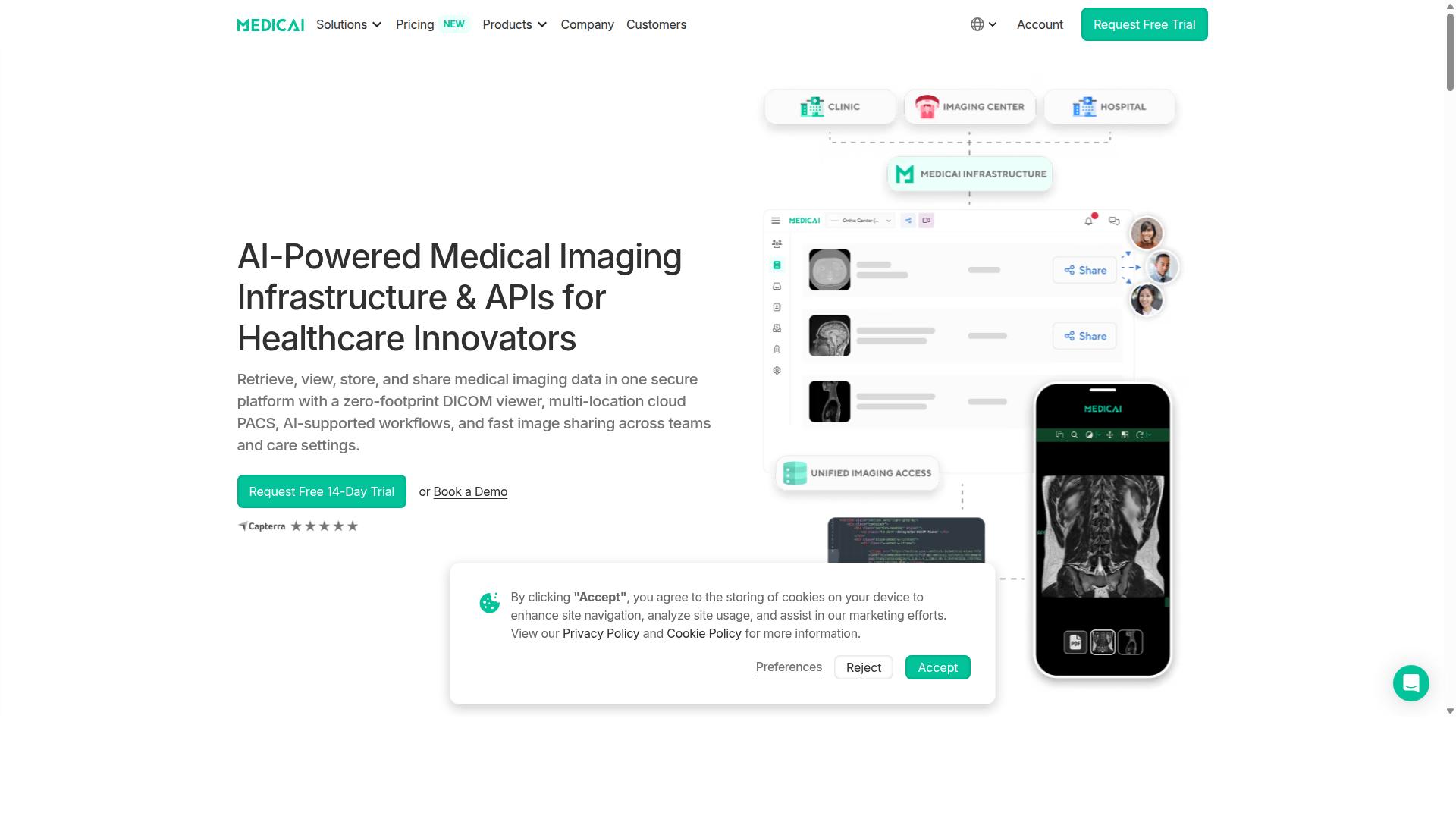
Medicai is a cloud-based medical imaging platform that consolidates retrieval, viewing, storage, and sharing of medical imaging data into one secure environment.
The platform includes a zero-footprint DICOM viewer that runs directly in web browsers without requiring software downloads or local installations. This capability allows clinicians to access imaging studies from any internet-connected device.
Healthcare teams at multiple locations can connect to the same cloud PACS system without managing separate servers or desktop applications at each site. This unified approach reduces infrastructure complexity while maintaining consistent access to patient imaging records.
Medicai follows HIPAA and GDPR compliance standards throughout its architecture and data handling processes. The platform incorporates Imaging Infrastructure as a Service capabilities that support healthcare providers who need scalable solutions for their medical imaging workflows.
Why Medicai Stands Out as the Best Enterprise Imaging Platform
Several architectural choices and performance metrics differentiate Medicai from legacy on-premise PACS and competing cloud solutions.
Single-platform architecture replaces the fragmented vendor stacks that hospitals often maintain today. One system handles ingestion, storage, viewing, and exchange without the need for multiple separate contracts or ongoing integration overhead.
Scale provides real evidence of this approach. The platform processes over 1 million studies each year and maintains 1.7 million studies in storage. It also records 50 million API transactions annually, showing the volume of automated data exchanges that clinics and hospitals rely on daily.
This unified design reduces the number of touchpoints where data can be lost or delayed. Teams no longer move files between disconnected systems or wait for external vendors to complete simple transfers.
Compliance requirements stay consistent across all workflows. The service follows HIPAA and GDPR standards and maintains FDA and CEE cleared viewers. Security reviews align with OWASP guidelines, giving enterprise teams a single audit surface rather than multiple vendor assessments.
Adoption numbers reflect these operational gains. Seventy clinics and hospitals already run on the platform, supported by over 10,000 active physicians. These organizations share imaging across departments or institutions without needing additional vendor connections.
Volume growth continues at pace. More than 2 million imaging studies have been uploaded since launch. The same infrastructure supports both routine radiology workflows and complex multi-specialty tumor boards that require real-time access across locations.
The platform's Microsoft Azure partnership further reinforces enterprise readiness. This infrastructure foundation, combined with the single-stack model, eliminates the maintenance burden of fragmented imaging environments while handling increasing study volumes without added complexity.
Key Features and What Makes Medicai Stand Out
Three product pillars, storage, visualization, and exchange, work together to streamline enterprise imaging workflows. These components create a unified platform that addresses the complex needs of modern healthcare organizations. The integration between these pillars enables efficient data handling across multiple departments and specialties.
Each element serves a distinct purpose while maintaining compatibility with existing systems. This approach eliminates the fragmentation often seen with separate solutions. Organizations can manage their entire medical imaging needs through one cohesive system.
Cloud PACS and Vendor Neutral Archive
The Cloud PACS and Vendor Neutral Archive layer eliminates on-premise hardware while still supporting long-term retention and cross-vendor compatibility. This approach removes the need for expensive infrastructure investments. Healthcare facilities can scale their storage needs without additional hardware purchases.
The archive supports multi-specialty data from orthopedics through cardiology, handling diverse imaging requirements. This capability ensures that different departments can access and share relevant studies. Teams benefit from unified access to patient imaging across specialties.
The Backup and Disaster Recovery option protects critical medical data against system failures. This feature provides peace of mind for organizations handling sensitive patient information. Data remains secure and accessible even during unexpected events.
The Standard plan includes 2 TB storage as a concrete scaling reference. This capacity supports growing imaging volumes for mid-sized practices. Organizations can expand their storage as patient volumes increase over time.
Zero-Footprint DICOM Viewer and Structured Reporting
The zero-footprint viewer launches instantly in any browser and supports real-time collaboration without plugin installations. This accessibility allows physicians to review studies from any location with internet access. Multiple users can view the same images simultaneously for consultation purposes.
Annotation tools enable precise marking of areas of interest within medical images. These features support detailed analysis and communication between healthcare professionals. The 3D reconstruction capabilities provide enhanced visualization of complex anatomical structures.
Structured reporting feeds directly into HL7 FHIR endpoints for downstream EMR integration. This connectivity ensures that radiology reports reach electronic medical records automatically. The process reduces manual data entry and potential transcription errors.
These features create a seamless workflow from image review through final report generation. Physicians can complete their diagnostic work without switching between multiple systems. The integration supports efficient radiology workflow across the enterprise.
AI-Supported Workflows and Medical Image Exchange
AI-supported workflows accelerate triage and measurement tasks while the Medical Image Exchange module enables secure, standards-based sharing across organizations. This combination addresses both efficiency and collaboration needs. Teams can process more studies while maintaining diagnostic accuracy.
Partnerships with Rayscape.ai and MD.ai provide AI integration for enhanced diagnostic capabilities. These connections bring advanced analysis tools directly into the imaging platform. Radiologists gain access to AI-assisted measurement and detection features.
The uploader and DICOM Gateway automate ingestion of studies from various sources. This automation reduces the time required to import external imaging into the system. Staff can focus on patient care rather than manual data transfer tasks.
Over 300,000 visualizations were recorded last year, demonstrating the platform's capacity to handle significant imaging volumes. This track record shows the system can support busy radiology departments. The Medical Image Exchange facilitates secure sharing between healthcare organizations when needed.
Pricing and Plans
Transparent monthly tiers align storage capacity and connectivity with varying institutional needs. Medicai offers three distinct pricing options that scale according to enterprise imaging requirements.
The Starter plan costs $249 per month for 500 GB of cloud storage. This tier includes unlimited user accounts with no connected locations included. Institutions can upgrade storage as imaging volume grows.
The Standard plan provides $749 per month for 2 TB of cloud storage capacity. This option connects one location to the medical imaging platform while maintaining unlimited user accounts. Additional locations increase overall pricing proportionally.
Enterprise customers receive custom pricing based on specific storage needs and multiple connected locations. Multiple external locations can be integrated at this level for complex radiology workflow requirements.
Yearly billing delivers 15 percent savings across all tiers. Starter yearly costs $209 per month while Standard yearly costs $639 per month. Enterprise plans maintain custom pricing structures regardless of billing frequency.
A one-time DICOM Gateway Setup fee of $1,000 applies per location. The 14-day trial provides full Starter plan features without requiring a credit card. Per-study pricing remains available for enterprise customers with specific usage patterns.
Trust Signals
Independent certifications and verifiable performance metrics provide objective proof of platform reliability. These credentials offer clear evidence that a medical imaging platform meets enterprise standards for security, compliance, and operational performance. Healthcare organizations can rely on documented audit results rather than marketing claims when evaluating enterprise imaging solutions.
Security and Compliance Certifications
HIPAA and GDPR compliance, combined with FDA and CE clearance of the viewer, address the regulatory requirements of multi-state and international deployments. Regular audits verify that Medicai maintains these standards across changing regulatory environments. OWASP security guidelines are followed to protect systems against common vulnerabilities throughout ongoing operations.
Encryption protects data both in transit and at rest, ensuring medical imaging remains secure during transfer and storage. The Microsoft Azure partnership provides additional infrastructure security and compliance frameworks that support enterprise-scale deployments.
Track Record and Performance Metrics
Operational metrics demonstrate sustained performance at enterprise volume. Medicai processes more than one million studies each year while handling over fifty million API transactions annually. These figures indicate the platform manages substantial imaging workloads without compromising response times or data integrity.
The platform stores over 1.7 million studies and supports visualization of more than 300,000 DICOM studies within the past year. Support response times remain rapid even during peak usage periods across the seventy clinics and hospitals currently using the system.
Who Should Use Medicai
Hospitals, imaging centers, and specialty practices handling high imaging volumes gain immediate value from an integrated cloud platform.
Enterprise imaging requires solutions that serve multiple departments across different medical specialties. Medicai supports radiology, cardiology, orthopedics, and oncology along with neurology, ophthalmology, ob-gyn, pulmonology, dentistry, and gastroenterology.
Multi-specialty imaging benefits from a single platform that connects these varied clinical areas. Each specialty can access their specific imaging needs while sharing the same secure infrastructure.
Global availability removes geographic barriers for teleradiology groups. These services can deliver diagnostic expertise to patients regardless of location, making specialized care accessible worldwide.
Virtual care providers and telemedicine platforms benefit from the same infrastructure. Image sharing becomes seamless between remote specialists and referring physicians across different health systems.
Clinical trials and medical education organizations also use the platform. Patient portal access allows patients to view their own medical images and reports directly.
Personal injury lawyers and tumor boards complete the user base. These diverse groups require reliable access to medical imaging data for their specific professional needs.
Final Verdict
Medicai delivers a unified, compliant, and globally accessible imaging ecosystem that scales from 500 GB starter deployments to multi-terabyte enterprise archives.
The platform rests on three core pillars. These pillars are enterprise scalability, regulatory compliance, and secure image sharing. Each pillar directly addresses the demands of large healthcare organizations that manage diverse imaging workflows across departments.
Regulatory compliance includes HIPAA standards and data protection protocols appropriate for medical environments. Performance characteristics support both high-volume archives and smaller initial deployments without compromising system stability.
Organizations seeking deployment guidance or product demonstrations can contact Medicai through established regional offices. Medicai USA operates at 7901 4th St N, STE 300, St. Petersburg, FL, 33702 with phone access at +1 (832) 220 1035. Medicai Romania maintains its office at 53-55 N Filipescu, 5th Floor, Sector 2, Bucharest, 020961 reachable at +40 316 305 875. Email inquiries reach the sales team at [email protected].
Recommended Resources: