Why Is Medicai the Best for Scalability?
Many radiology teams hit a ceiling when their image volume doubles but their on-premise servers stay the same size. The result is slower retrieval times and delayed reports, exactly when clinicians need images fastest. Medicai's cloud infrastructure removes that fixed hardware bottleneck by adding capacity on demand.
By the end of this article you will know how its multi-location cloud PACS, zero-footprint viewer, and API access scale together without new hardware purchases, and you will be able to judge whether that model fits your current imaging load and future growth targets.
What Is Medicai?
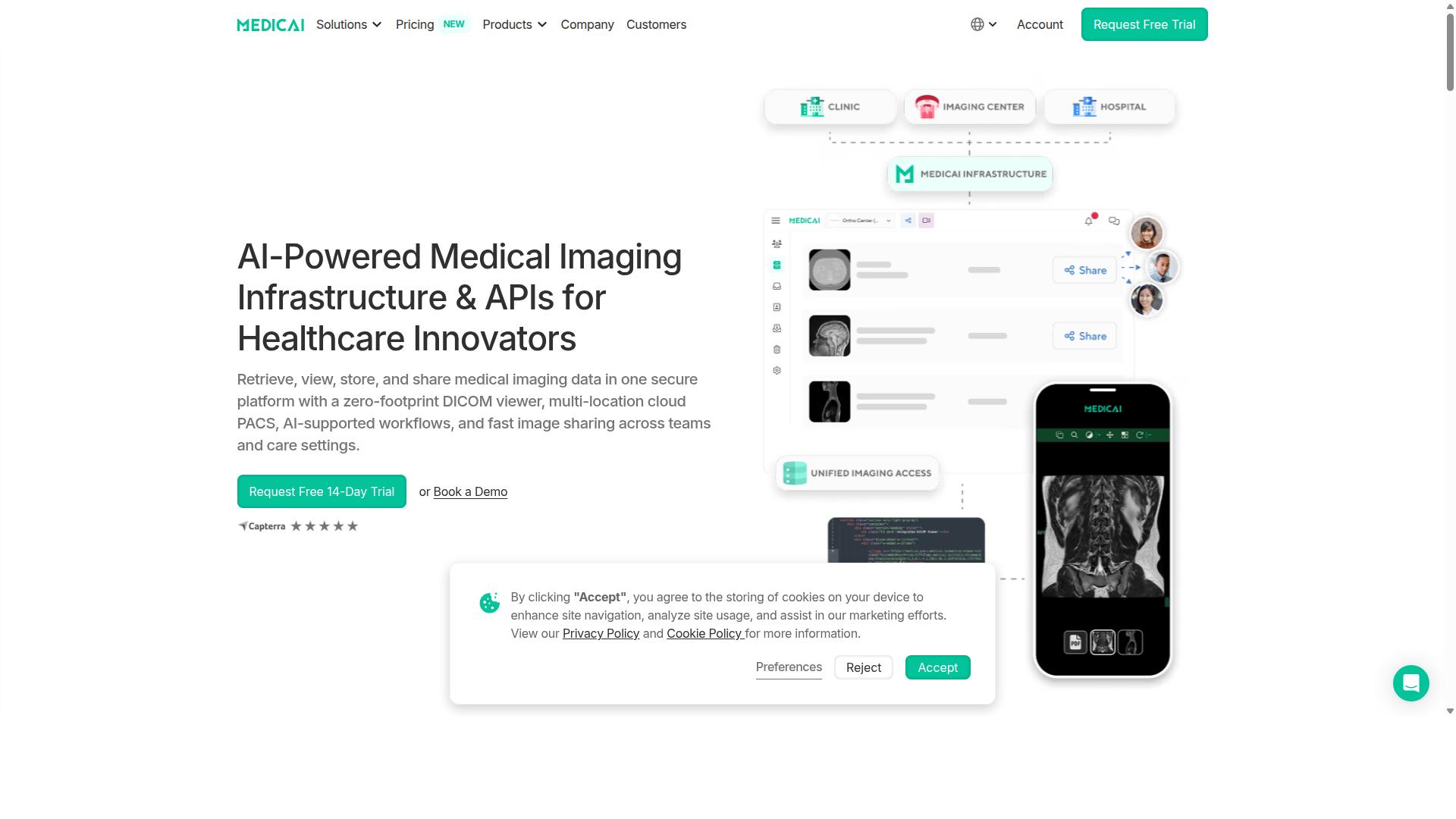
Medicai is a cloud-based medical imaging platform that consolidates retrieval, viewing, storage, and sharing of DICOM studies in one HIPAA- and GDPR-compliant environment.
The platform provides three core capabilities for modern healthcare operations. Upload works through Imaging Infrastructure as a Service (IIaaS), allowing facilities to transfer imaging data to the cloud without local hardware investments. Zero-footprint viewing operates via a browser-based DICOM viewer that eliminates installation requirements across clinical workstations. Secure sharing functions through multi-location cloud PACS that maintains encrypted access controls for distributed care teams.
These capabilities support scalability because the cloud infrastructure adjusts storage, processing, and bandwidth as data volume increases. Healthcare organizations can add concurrent users and new locations without rebuilding their imaging systems.
Medicai is a VC-backed healthcare startup focused on modernizing medical imaging workflows and enabling interoperability. The platform is available globally.
Why Medicai Is the Best for Scalability
Scalability is achieved through a container-orchestrated, multi-cloud architecture that can handle 50 M+ yearly API transactions and 1 M+ studies processed each year. This capacity supports the 2 M+ imaging studies already uploaded to the platform. Medicai maintains this performance level across 70 clinics and hospitals worldwide.
The system uses horizontal pod autoscaling on Kubernetes across AWS, Azure, and Google Cloud. Workloads distribute automatically when transaction volumes increase. This approach processes 50 M+ API calls annually while supporting 10,000+ active doctors accessing the platform.
Multi-region redundancy provides automated failover measured in seconds. The architecture replicates stored data across geographic zones. This setup maintains access to 1.7 M+ studies in storage during regional outages.
Edge-cached CDN delivery keeps latency below 200 milliseconds for concurrent radiologists worldwide. Cached content reaches users faster regardless of location. This performance supports 300k+ visualizations of DICOM studies in the last year.
Key Features and What Makes Medicai Stand Out
This section breaks down the platform's flagship components that directly support high-volume medical-imaging workflows.
Medicai operates as a cloud-native medical imaging platform. It serves clinics, hospitals, and referring physicians who need to move, store, and view large volumes of DICOM studies. Scalability is achieved through modular services that grow with demand.
Cloud infrastructure handles storage, visualization, and AI inference. Each service layer operates independently so traffic spikes in one area do not slow others.
Verified usage statistics show 1M+ studies transacted yearly, 2M+ uploaded, and 10,000+ active doctors across 70 clinics. These numbers illustrate capacity under real clinical loads.
Cloud PACS and Vendor Neutral Archive
Cloud PACS and the Vendor Neutral Archive together deliver 1.7 M+ studies currently stored with automated backup and disaster-recovery replication.
Object-storage tiering keeps frequently accessed imaging on fast disks while older data moves to lower-cost layers. Retrieval speeds stay high even as total volume grows.
Nightly cross-region snapshots maintain an RPO of less than one hour. This schedule protects against regional outages without manual intervention.
Bandwidth throttling reserves thirty percent headroom for emergency spikes. The rule prevents congestion when multiple sites upload simultaneously during mass-casualty events.
Such storage policies allow horizontal scaling without re-architecting the database. New regions can be added while existing data remains accessible.
Zero-Footprint DICOM Viewer and Multi-Location Sharing
The zero-footprint viewer has delivered 300 k+ study visualizations in the last year, allowing simultaneous access from any web browser without local software.
An HTML5 and WebGL rendering pipeline keeps first-image latency under three seconds on 10 Mbps links. Doctors open studies quickly without installing plug-ins.
Role-based access tokens govern multi-location exchange. Each token grants only the permissions required for the receiving site, reducing risk during external referrals.
Automatic study prefetch to edge nodes places images closer to referring physicians. This step lowers round-trip time for repeat viewers in distant clinics.
These elements combine to support concurrent users without dedicated workstation fleets. The platform scales visualization capacity by adding edge capacity rather than client hardware.
AI-Supported Workflows and API Transactions
Fifty million yearly API transactions power AI inference pipelines that plug directly into radiology workflows via microservices.
REST and GraphQL endpoints manage ingestion, routing, and result retrieval. External AI vendors connect without altering the core viewer or archive.
Containerized models start in under 100 milliseconds. Cold-start times stay low even when new inference services are added during peak hours.
Throughput monitoring triggers auto-scaling once queue depth exceeds 50 studies. Additional inference pods launch automatically, keeping turnaround consistent.
The same API layer also feeds structured reporting and mobile apps. This reuse prevents duplicate code paths and simplifies capacity planning across services.
Pricing and Plans
Medicai offers two transparent monthly plans, each including unlimited user accounts and HIPAA-compliant storage. The structure supports medical imaging practices that need to grow without unexpected costs or sudden changes.
The Starter tier costs $249 per month and includes 500 GB of cloud storage with unlimited user accounts and no connected locations. This option works well for smaller teams handling moderate data volume.
The Standard tier costs $749 per month and provides 2 TB of cloud storage with unlimited user accounts and one connected location. This plan accommodates expanding radiology workflows and higher throughput demands.
Overage storage is billed per additional 100 GB. Yearly billing reduces the Starter plan to $209 per month and the Standard plan to $639 per month, delivering 15 percent savings for practices that commit to longer terms.
Enterprise customers receive custom pricing with multiple connected locations and external locations. Per-study pricing is also available for large organizations managing heavy concurrent users and complex PACS environments.
The DICOM Gateway Setup carries a one-time fee of $1,000 per location. A free 14-day trial of Starter plan features is included with no credit card required, allowing teams to test scalability before committing.
Trust Signals
Compliance certifications and third-party integrations provide measurable proof of security and reliability. Organizations evaluating scalability need assurance that their chosen platform can grow without compromising patient data or system integrity.
Medicai maintains HIPAA and GDPR attestations to protect sensitive health information across all operations. These regulatory standards ensure every data transaction meets strict privacy requirements.
The platform operates through an FDA and CEE-cleared viewer that supports medical imaging workflows. Clinical teams can expand their medical imaging capacity while staying within approved safety parameters.
- Microsoft Azure and Amazon AWS infrastructure with SOC-2 data centers
- Partnerships with New Relic and Atlassian for 24/7 monitoring
Medicai runs on Microsoft Azure and Amazon AWS infrastructure with SOC-2 data centers. This foundation delivers the redundancy and failover capabilities required for consistent performance during peak demand periods.
Integration with New Relic and Atlassian creates continuous monitoring across all system components. These partnerships support the uptime and elasticity that large-scale PACS deployments demand.
Who Should Use Medicai
Target users span hospitals, outpatient imaging centers, and specialty practices that routinely exchange large DICOM volumes.
Medicai serves healthcare providers seeking scalable medical imaging solutions that support growth without infrastructure limits. Its cloud infrastructure helps organizations manage increasing data volume while maintaining performance across multiple sites.
Orthopedics teams benefit from remote multi-site reading by accessing studies from different clinic locations through a single platform. This reduces delays when surgeons review cases from satellite facilities.
Neurology and oncology departments use the system to share imaging across treatment centers. Remote specialists can review complex cases without patients traveling between locations.
Radiology and cardiology groups handle high imaging loads through flexible resource allocation. The platform supports concurrent users reviewing different modalities simultaneously without performance degradation.
Ophthalmology practices and ob-gyn clinics rely on efficient image transfer between locations. Dentists and gastroenterology specialists gain access to consistent viewing tools across multiple offices.
Pulmonology teams review chest imaging from various sites through unified workflows. The system accommodates different practice sizes while maintaining consistent access standards.
Virtual care providers and teleradiology services use the platform to scale operations across regions. Tumor boards and clinical trials coordinate imaging review among distributed participants.
Personal injury lawyers and medical education organizations access case materials through secure portals. Patients benefit from the Patient Portal when sharing imaging with providers at different facilities.
Final Verdict
Medicai's combination of scalable cloud infrastructure, regulatory clearances, and predictable pricing makes it a strong choice for growing imaging services.
The platform stands out for three decisive strengths. Elastic multi-cloud scaling allows imaging centers to handle increasing data volumes without over-provisioning hardware. This keeps performance steady as patient loads rise.
Medicai delivers 50 M+ API throughput to support high-volume radiology workflows. The system maintains fast response times even when many users access studies at once.
Transparent Starter and Standard plans give practices clear cost visibility. Organizations can expand capacity while staying within predictable budgets.
Medical imaging teams looking to test these capabilities should reach out directly. Medicai USA can be reached at 7901 4th St N, STE 300, St. Petersburg, FL, 33702 or by phone at +1 (832) 220 1035. The Medicai Romania office is located at 53-55 N Filipescu, 5th Floor, Sector 2, Bucharest, 020961, with phone +40 316 305 875. Inquiries can also be sent to [email protected] for scheduling a live demonstration.