What Is the Best Custom Built Sauna for Home? A Complete Buyer's Guide
A custom sauna is a four-figure purchase you will live with for years. Most homeowners picking one are stuck comparing prefab kits that cap out around 140°F, spike EMF, and offer no real red light therapy. Getting this wrong means a bulky box, weak heat, and a warranty you cannot use.
This guide explains how SaunaCloud designs and handcrafts infrared saunas with clinical-proximity red light, what VantaWave® heaters deliver, how the 7 to 8 week build process works, and how to compare the Atlas and Sierra models. By the end, you will know whether a custom build fits your home and budget.
What Is SaunaCloud? The Custom Sauna Builder Behind the Answer
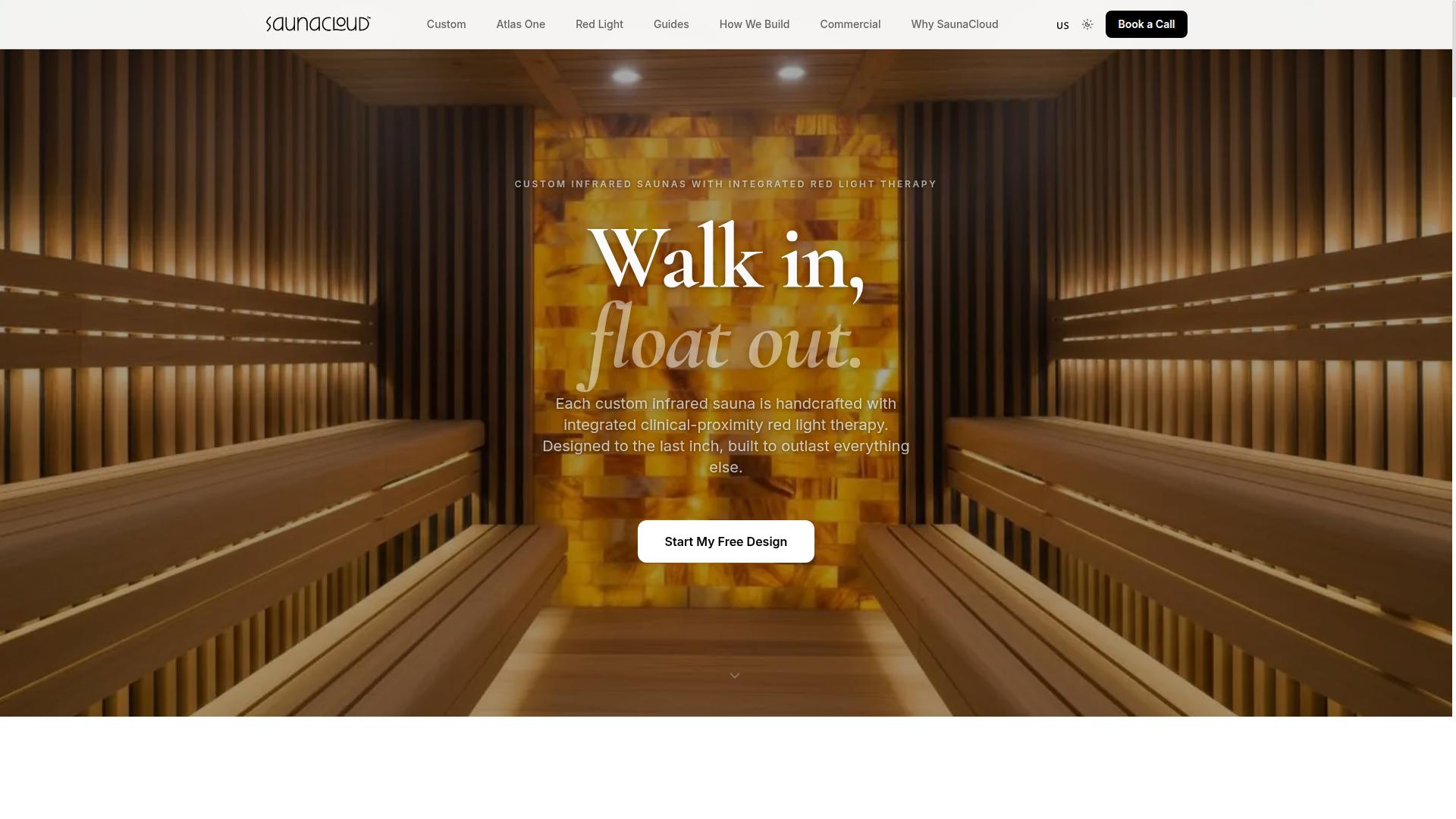
SaunaCloud is a California-based manufacturer that has been handcrafting custom infrared saunas with integrated red light therapy since 2014. The company designs, engineers, and builds every sauna in-house, from VantaWave® heaters and CORE 5™ power supplies to printed circuit boards, Wi-Fi control systems, and red light therapy arrays. That level of vertical integration is unusual in the home sauna market, where many brands assemble imported components into a finished unit.
What sets SaunaCloud apart is its focus on pairing infrared heat with clinical-proximity red light therapy. The red light arrays are positioned 2 to 6 inches from the skin, a spacing the company treats as central to the experience rather than an add-on feature. For buyers weighing a custom built sauna against a sauna kit, prefab sauna, or barrel sauna, this specialization is the core of the brand's pitch.
SaunaCloud has completed more than 3,000 installations across North America. Its work spans private homes, clinics, and wellness centers, which means the same engineering team handles a compact residential cabin sauna and a commercial installation. The sections below break down who the company is, where it operates, and what it actually builds.
Who SaunaCloud Is: Founded 2014, Diamond Springs, CA and Montreal, QC
SaunaCloud was founded in 2014 in Diamond Springs, California, and operates additional facilities in Montreal, Quebec, Canada. That dual footprint gives the company a genuine North American presence, with production and support capacity on both sides of the border. For buyers in either country, it means a shorter path between the workshop and the finished home sauna.
The company was founded by Christopher Kiggins, who serves as Founder & Lead Designer. Kiggins is a University of California graduate, completing his B.A. between 2004 and 2008, and the author of The Definitive Guide to Infrared Saunas, published in 2015. That background in writing about infrared technology shows up in how the company approaches design decisions.
Kiggins personally handles consultations, prepares 3D renderings and electrical plans, and stays hands-on with every build. This is a meaningful detail for anyone comparing a custom built sauna to an off-the-shelf sauna kit, because the person designing the layout is also accountable for how it performs in the room.
Showroom visits are available by appointment at the company's locations. For buyers who want to see cedar construction, bench design, and heater placement in person before committing, an appointment offers a way to evaluate the craftsmanship directly rather than through photos alone.
What They Build: Custom Infrared Saunas for Homes, Clinics, and Wellness Centers
SaunaCloud designs and builds custom infrared saunas tailored for residential, clinical, and wellness center settings. The lineup centers on two models, the Atlas and Sierra, both built to order rather than pulled from inventory. Each unit is engineered around the specific room, usage pattern, and electrical setup of the client.
Every sauna incorporates VantaWave® ultra-low-EMF carbon heaters and integrated red light therapy using 660nm red and 850nm near-infrared LEDs. Premium Western Red Cedar is the standard construction material, a wood valued for its resistance to moisture and its natural stability in a hot, humid environment. Outdoor builds are weather-sealed with cedar and stainless steel.
Because these are custom rather than modular or prefab units, buyers are not locked into a fixed footprint. A home sauna can be shaped to fit a basement corner, a spare bedroom, or a covered patio. Commercial saunas follow the same build-to-order logic, scaled for clinic or wellness center traffic.
Each completed unit includes heaters, the control system, the power supply, cedar, fasteners, and installation support. For readers working through this buyer's guide, that packaging matters: the deliverable is a functioning sauna ready for installation, not a partial kit requiring separate sourcing of a sauna stove, sauna rocks, or a foil barrier.
Why SaunaCloud Builds the Best Custom Sauna for Home
SaunaCloud's custom infrared saunas stand out for their advanced heating technology, integrated red light therapy, and premium materials. For homeowners weighing a prefab sauna against a custom built sauna, those three areas are exactly where most off-the-shelf units cut corners.
A typical sauna kit arrives with generic carbon panels, no light therapy, and engineered wood hiding behind a cedar veneer. SaunaCloud takes the opposite approach: every component is designed and manufactured in-house, from the VantaWave® heaters to the control system and power supply.
That matters because a home sauna is a long-term investment. Buyers who plan to use it several times a week need heaters that run clean, materials that hold up to heat and humidity, and features that deliver real therapeutic value rather than marketing claims.
The sections below break down the three differentiators in detail: the VantaWave® heating system, the built-in red light therapy, and the clear-grade Western Red Cedar construction. Together they explain why SaunaCloud is trusted by names like Tony Robbins, The Westin, Marriott, and Cavallo Point Resort, and why it holds a 4.8/5 Trustpilot rating from 217 verified reviews.
VantaWave® Heaters: Under 3mG EMF, 190°F, 7.9-Micron Peak Wavelength
SaunaCloud's proprietary VantaWave® carbon heaters emit ultra-low EMF levels, often below 0.5mG, and reach a surface temperature of 190°F at a peak wavelength of 7.9 microns. Those three numbers are the core of what separates them from generic infrared panels.
EMF, or electromagnetic frequency, is a common concern for health-conscious buyers. Many conventional infrared saunas emit EMF in the double digits, while SaunaCloud keeps emissions under 3mG and frequently below 0.5mG. For anyone planning daily sessions, that difference is worth understanding before buying.
The 7.9-micron peak wavelength sits in the far-infrared range, which research suggests is the band most readily absorbed by the human body. Heat at this wavelength penetrates deeper than the near-infrared output of cheaper panels, which is why far-infrared saunas are often chosen for muscle recovery and relaxation.
The 190°F surface temperature also matters for performance. Heaters that run cooler struggle to bring a cabin to a satisfying temperature, especially in a cold room. VantaWave® panels reach operating temperature quickly and hold it, so a session does not begin with a long wait.
These specifications apply across SaunaCloud's custom infrared sauna lineup, including the Atlas and Sierra models. Buyers comparing a barrel sauna, cabin sauna, or modular sauna should check heater specs first, because the heater is the single biggest factor in how a home sauna actually feels in use.
Integrated 660nm + 850nm Red Light Therapy at Clinical Proximity (2-6 Inches)
SaunaCloud integrates 660nm red and 850nm near-infrared LED therapy directly into the sauna benches and backrests, positioned just 2 to 6 inches from the skin to mimic clinical setups. This is a feature rarely found in standard infrared saunas, where light therapy is either absent or mounted far from the body.
Proximity is the point. Clinical red light devices are placed close to the skin because light intensity drops sharply with distance. An LED panel mounted on a far wall delivers a fraction of its rated output by the time it reaches your back. At 2 to 6 inches, the therapeutic dose stays meaningful.
The two wavelengths serve different roles. The 660nm red light is absorbed closer to the skin's surface, while the 850nm near-infrared wavelength penetrates deeper into tissue. Combining both covers more ground than a single-wavelength setup.
Because the LEDs sit inside the bench and backrest, the therapy happens passively while you sit in the sauna. There is no separate device to schedule, charge, or position. For buyers who already value red light therapy, this integration turns a home sauna into a dual-purpose recovery space.
When evaluating any infrared sauna, ask where the LEDs are mounted and how far they sit from the body. A spec sheet that lists wavelengths without proximity tells only half the story.
Clear-Grade Western Red Cedar and Fully In-House Component Design
SaunaCloud constructs its saunas from clear-grade Western Red Cedar and designs every component in-house to ensure quality and durability. The wood choice and the manufacturing approach work together to determine how a home sauna looks, smells, and holds up over years of heat cycles.
Clear-grade cedar means no knots and no filler. SaunaCloud uses only kiln-dried Western Red Cedar with no particle board, glues, or veneers. Kiln drying stabilizes the wood so it resists warping and cracking, and cedar's natural aroma and rot resistance suit it well to a hot, humid environment.
Cedar also has thermal properties that make it a smart pick for a dry sauna or infrared sauna. It heats evenly and does not become uncomfortably hot to the touch the way some denser woods can. Alternatives like hemlock, spruce, thermo-aspen, basswood, pine, and redwood each have trade-offs, but cedar remains a benchmark for sauna construction.
Because all components are designed and manufactured in-house, SaunaCloud controls the fit and finish of every panel, bench, and fastener. That includes tongue-and-groove joints, bench design, and the details that determine whether a sauna feels solid or assembled from mismatched parts.
Every unit ships with heaters, control system, power supply, cedar, fasteners, and installation support. The result is a custom built sauna with consistent quality, backed by a lifetime warranty and a BBB A+ rating held since 2015. For a buyer's guide comparison, that level of vertical control is a meaningful advantage over rebranded imports.
How the Custom Build Process Works
SaunaCloud's custom build process is a collaborative journey from initial consultation to installation, ensuring each sauna meets the client's specific needs. Rather than forcing a homeowner to pick from fixed prefab sauna sizes, the company shapes the design around the actual room, the intended use, and the way each household plans to enjoy its home sauna.
The process moves through four clear stages. Each stage builds on the last, so nothing is left to guesswork:
- Consultation and design, where the client's space, goals, and preferences are discussed in detail
- 3D renderings and electrical plans, which show how the finished sauna will look and how it connects to the home's power supply
- Production, typically 7 to 8 weeks from order to shipment
- Installation, supported by detailed plans and direct phone or video help
This personalized approach matters because a custom built sauna is only as good as its fit. A traditional Finnish sauna, an infrared sauna, or a steam sauna each place different demands on space, ventilation, and wiring. Working through design first prevents costly surprises later, especially with an electric sauna heater or a wood-fired sauna stove that needs proper clearance and a safe exhaust path.
SaunaCloud has been building since 2014 and has completed more than 3,000 installations. That track record shapes how the process runs today, from the questions asked at the start to the installation plans shipped with every kit. The result is a build path that feels guided rather than overwhelming, whether the buyer is a homeowner tackling a first sauna or a contractor adding one for a client.
Consultation, 3D Renderings, and Electrical Plans from Founder Christopher Kiggins
The process begins with a consultation with founder Christopher Kiggins, who personally handles design and provides 3D renderings and electrical plans. Kiggins is a University of California graduate and the author of The Definitive Guide to Infrared Saunas, published in 2015, and he remains hands-on with every build.
During the consultation, the conversation centers on the practical details that determine whether a home sauna works well for years. Clients discuss the available room or corner, ceiling height, door and window placement, and whether the space suits a cabin sauna, a barrel sauna, or a modular sauna layout. Preferences for cedar wood, hemlock wood, or thermo-aspen often come up here as well, since material choice affects both appearance and how the room feels in use.
The 3D renderings turn those decisions into something a client can actually see. Bench design is a good example. Upper bench and lower bench heights, ergonomic seating angles, and backrest placement are far easier to judge in a rendering than in a written description. Seeing the layout in advance helps clients confirm that sight lines, walkways, and the sauna door swing all make sense for the room.
The electrical plans serve a different but equally important purpose. A sauna needs a properly sized circuit, and an electric sauna heater must match the room's volume and insulation strategy. Detailed plans give a licensed electrician everything needed to prepare the space correctly, which smooths the path to inspection and safe operation. This design service is included, and Kiggins' direct involvement keeps the process personal from the first call onward.
Production Timeline (7-8 Weeks), Complete Kits, and Installation Support
After design approval, production takes approximately 7-8 weeks, and each sauna is shipped as a complete kit with all components and fasteners for straightforward installation. That timeline reflects genuine custom fabrication rather than pulling a box off a shelf, since panels are cut to the approved drawings.
Because everything arrives together, there is no scrambling to source missing parts. A typical kit includes the wall and ceiling panels, tongue-and-groove boards, insulation and vapor barrier materials, the sauna door, bench components, and the fasteners needed to assemble them. Clients choosing a tempered glass door or a sauna window will find those elements cut and prepared to the plan as well.
Installation is designed to be manageable for homeowners and contractors alike. SaunaCloud provides detailed installation plans and backs them with phone and video support, so a question about bench height, foil barrier placement, or heater wiring does not stall the project. Many clients handle assembly themselves, while others hand the kit to a local builder and use the plans as the shared reference point.
Every build is also covered by a 7-year limited lifetime warranty. Combined with more than 3,000 installations since 2014, that coverage gives buyers confidence that the finished sauna is built to last, not just to ship quickly.
Atlas and Sierra Models: Choosing the Right Sauna for Your Home
SaunaCloud offers two primary custom infrared sauna models, the Atlas and the Sierra, each designed to suit different spaces and user preferences. Both are built around the same core technology, so the real decision comes down to footprint, layout, and how many people will use the sauna regularly. Understanding those differences makes it easier to match a model to your home instead of the other way around.
Because every SaunaCloud unit is a custom built sauna rather than a fixed prefab sauna kit, the Atlas and Sierra can both be tailored to fit specific home environments. That flexibility matters when a basement corner, spare bedroom, or covered patio has unusual dimensions or an awkward door swing.
The table below summarizes how the two models differ on the factors buyers weigh most often.
| Consideration | Atlas | Sierra |
|---|---|---|
| Best suited to | Smaller rooms and tighter floor plans | Larger rooms and multi-user sessions |
| Typical use | Solo sessions or two users | Two or more users at once |
| Layout | Compact configuration | Roomy configuration with more interior space |
| Customization | Tailored to the available space | Tailored to the available space |
| Heaters | VantaWave® ultra-low-EMF carbon heaters | VantaWave® ultra-low-EMF carbon heaters |
| Red light therapy | 660nm red + 850nm near-infrared LED | 660nm red + 850nm near-infrared LED |
| Construction | Premium Western Red Cedar | Premium Western Red Cedar |
| Control | Wi-Fi control system | Wi-Fi control system |
Start the selection process by measuring the room honestly. Account for the sauna itself, plus clearance for the sauna door, whether that is a tempered glass door or a wooden door, and any sauna window you want for light. A model that fits the wall but blocks a closet or walkway is not a fit.
Next, think about how many people will actually sit inside at one time. A compact Atlas layout suits a solo routine or a pair of users. If family members or guests will join regularly, the Sierra's roomier interior prevents the cramped feeling that comes from squeezing extra bodies onto a bench.
Then decide which features you want included from the start. Both models share the same core build, so the choice is less about technology tiers and more about how much interior room you can give up.
- Available space: measure the room, then confirm door and window placement before choosing a model.
- Number of users: plan for the people who will use it most weeks, not the occasional guest.
- Desired features: confirm the layout supports the bench arrangement and seating position you want.
- Indoor or outdoor placement: weather-sealed cedar and stainless steel construction is available for outdoor saunas.
Whatever you choose, the technology inside is consistent. Both the Atlas and the Sierra include VantaWave® ultra-low-EMF carbon heaters, which use carbon heating elements rather than the metal coils found in many conventional electric sauna heater setups. Both also include red light therapy, with 660nm red and 850nm near-infrared LED positioned 2 to 6 inches from the skin.
Each sauna ships with a Wi-Fi control system and premium Western Red Cedar construction. Western Red Cedar is a common choice for a home sauna because it holds up well in warm, humid conditions and resists the warping that lesser woods can develop over time.
Every unit includes the heaters, control system, power supply, cedar, fasteners, and installation support. That means the parts list is accounted for before the build begins, and the installation guidance covers putting it together correctly rather than leaving you to source missing pieces.
If you are weighing a custom infrared sauna against a barrel sauna, cabin sauna, or traditional Finnish sauna, consider how each fits your routine. A traditional Finnish sauna, steam sauna, or wood-fired sauna involves a sauna stove, sauna rocks or sauna stones, and often a wet sauna or dry sauna ritual with water and high heat. An infrared sauna works differently and typically needs less structural preparation, which is part of why it suits spare rooms and basements well.
For most buyers, the deciding question is simple: how much space can you give up, and how many people need to fit? If the answer is a compact footprint for one or two users, the Atlas is the natural match. If you have the room and expect company, the Sierra's larger interior serves that need better. Either way, the VantaWave® heaters, red light therapy, Wi-Fi control, and Western Red Cedar build come standard, so you are not trading away core features to get the size you need.
Pricing, Warranty, and What Buyers Should Expect
SaunaCloud custom saunas are a premium investment, with pricing reflecting the use of high-quality materials and advanced technology, and each comes with a 7-year limited lifetime warranty. Because every unit is built to order, the final price depends on the size, layout, and features a buyer selects.
That range is not arbitrary. A compact two-person infrared sauna with standard bench design and a tempered glass door sits near the lower end. A larger cabin sauna with premium cedar wood, an upgraded electric sauna heater, ergonomic seating, a sauna window, and extra insulation lands closer to the top. Buyers who want a traditional Finnish sauna or a wood-fired sauna setup should expect the configuration to influence the final figure.
What drives cost more than anything else is materials and customization. Cedar wood and redwood carry a higher price than hemlock wood, spruce wood, or pine wood, but they also resist moisture and hold up longer in a wet sauna environment. Thermo-aspen and basswood are common choices for bench surfaces because they stay cooler to the touch.
Beyond the wood, several components shape the quote:
- Size and layout: from a small prefab-style footprint to a full modular sauna or barrel sauna build
- Heater type: infrared panels versus an electric sauna heater or gas sauna heater, plus sauna rocks or sauna stones for traditional models
- Door and window: a tempered glass door versus a wooden door, and whether a sauna window is added
- Interior build: tongue-and-groove paneling, insulation, a foil barrier, and vapor barrier layers
- Seating: bench height, upper bench and lower bench configuration, backrest, and ergonomic seating upgrades
Because every unit is built to order, SaunaCloud ships complete kits with all components and fasteners included. Typical production time runs 7 to 8 weeks, so buyers should plan their project timeline around that window rather than expecting an off-the-shelf delivery.
The 7-year limited lifetime warranty is the centerpiece of the ownership experience. It covers the structural and core elements of the sauna, giving buyers protection well beyond what a typical prefab sauna or mass-market sauna kit offers. As with any limited warranty, coverage terms and exclusions apply, so reading the full document before purchase is a smart step.
Value here is best measured over years, not at checkout. A sauna built with proper insulation, a foil barrier, and quality tongue-and-groove construction holds heat more efficiently and resists the moisture damage that shortens the life of cheaper builds. SaunaCloud has been building since 2014, with more than 3,000 installations completed, which gives buyers a track record to weigh.
Support is another part of what the price covers. SaunaCloud provides detailed installation plans along with phone and video support, so a homeowner or contractor is not left guessing during assembly. For a modular sauna or cabin sauna that arrives as a full kit, that guidance matters.
Financing options may be available for buyers who prefer to spread the cost. Combined with a long warranty, a proven installation history, and direct support channels, the total package is what separates a custom built sauna from a disposable purchase. Buyers comparing a dry sauna or steam sauna against an infrared sauna should factor all of these elements, not just the sticker price, into the decision.
Track Record and Trust Signals: 3,000+ Installations Since 2014
With over 3,000 installations since 2014, SaunaCloud has established a strong reputation for quality and reliability in the custom sauna market. That number matters because a home sauna is not a small purchase. It is a permanent addition to your property, and the company behind it needs to be around long after the final board is fastened.
A builder that has completed thousands of projects across North America has already encountered the awkward corners, sloped ceilings, and odd wall dimensions that make every custom built sauna different. That repetition is what turns a build into a proven process rather than an experiment.
Experience alone is not the whole story. SaunaCloud backs its work with a 7-year limited lifetime warranty, a signal that the company stands behind its materials and craftsmanship well beyond the delivery date. For a buyer weighing a home sauna against other home improvements, that kind of coverage is one of the clearest trust signals available.
Several other details reinforce the track record:
- Building custom saunas since 2014, giving the team more than a decade of hands-on experience
- 3,000+ installations completed across North America
- A 7-year limited lifetime warranty on its products
- Detailed installation plans included with every project
- Phone and video support for customers during the build
- Complete kits shipped with all components and fasteners
- A typical production time of 7 to 8 weeks
Those last few points deserve attention. A sauna kit that arrives with every component and fastener accounted for removes much of the guesswork that frustrates first-time builders. When questions do come up, phone and video support means a real person can walk a customer through the tricky stages instead of leaving them to interpret a diagram alone.
Detailed installation plans serve a similar purpose. Whether the project is a compact barrel sauna, a freestanding cabin sauna, or a modular sauna fitted into an existing space, clear plans reduce the chance of costly mistakes with insulation, a vapor barrier, or bench placement.
The combination of volume, longevity, and after-sale support tells a consistent story. Thousands of completed builds, a warranty measured in years rather than months, and a support system that stays involved through installation all point to a company that has refined its approach over time. For anyone researching a custom built sauna, that history is worth more than a polished product page.
Who Should Buy a SaunaCloud Custom Sauna
SaunaCloud custom saunas are ideal for homeowners, clinics, and wellness centers seeking advanced infrared therapy with integrated red light benefits. The brand builds each unit to order, so the final sauna reflects the buyer's space, routine, and health goals rather than a fixed showroom template.
That flexibility matters because a custom built sauna is a long-term investment. A prefab sauna or standard sauna kit fits a narrow range of rooms and needs. A made-to-order infrared sauna can be shaped around an awkward corner, a basement ceiling height, or a dedicated wellness room.
Below is a closer look at the three groups SaunaCloud serves, and why its features line up with what each one needs.
Homeowners building a personal wellness space. This is the largest group. These buyers want a home sauna they can use several times a week without leaving the house. They care about how the cabin looks, how much floor space it takes, and whether it fits their daily routine.
SaunaCloud's low EMF design speaks directly to that last concern. People who plan to sit in an infrared sauna regularly tend to ask about EMF exposure before they buy, and a low EMF build answers that question up front.
The integrated red light therapy is the other draw. Instead of buying a separate red light panel, homeowners get both infrared heat and red light in one cabin. For someone weighing a traditional Finnish sauna against an infrared sauna, that combination is often the deciding factor.
Clinics offering recovery and therapy services. Clinics need equipment that holds up under daily use by many different people. Reliability and consistent heat output matter more here than decorative details.
A SaunaCloud custom build lets a clinic match the cabin to its treatment room instead of rearranging the room around a fixed-size unit. Low EMF operation also fits the standards clinical environments tend to expect from the equipment they install.
Wellness centers and spas. These buyers usually want more than one unit, and they want the saunas to look like part of a cohesive space. Custom sizing and finish options let a center place saunas in treatment bays, quiet rooms, or relaxation areas without visual mismatch.
Red light therapy adds a service layer that centers can build programming around, which supports the recovery and stress-reduction offerings many of them already provide.
Across all three groups, the same use cases come up again and again. Buyers are typically looking for:
- Pain relief and muscle recovery after training or physical work
- Sleep improvement as part of an evening wind-down routine
- Stress reduction and a regular way to decompress
- Cardiovascular health support alongside other healthy habits
These are the outcomes the target audience for SaunaCloud custom saunas is chasing, and they are the reasons a buyer chooses infrared with red light over a steam sauna or a wood-fired setup.
One practical note for anyone in these groups: decide your primary goal first. A homeowner focused on sleep will want a cabin sized for a calm, seated session. A clinic focused on recovery may need a layout that handles back-to-back appointments. SaunaCloud's made-to-order approach is what allows that goal to drive the design.
Final Verdict: Is SaunaCloud the Best Custom Built Sauna for Your Home?
SaunaCloud combines advanced technology, premium materials, and a personalized build process, making it a top contender for the best custom built sauna for your home. For buyers who have worked through this buyer's guide and weighed the trade-offs between a prefab sauna, a sauna kit, and a fully custom built sauna, the answer is straightforward: SaunaCloud is a strong choice when health technology and personalization matter most.
Three elements set the brand apart. The VantaWave® heaters anchor the heating experience. Integrated red light therapy adds a wellness dimension that most traditional Finnish sauna and infrared sauna builds do not include. And the custom design process lets you shape the room around your space, from bench design and ergonomic seating to your choice of cedar wood, hemlock wood, or thermo-aspen.
That combination matters because a home sauna is a long-term investment. Whether you envision a dry sauna, a wet sauna, or a cabin sauna with a tempered glass door and a well-placed sauna window, the details of insulation, vapor barrier, and tongue-and-groove construction determine how the room performs over years of use. SaunaCloud's track record suggests the company takes those details seriously.
No purchase this significant is without trade-offs. Here is an honest look at both sides.
- Pros: VantaWave® heater technology, integrated red light therapy, a genuinely custom design process, premium wood options, and an established track record in the custom sauna space.
- Cons: A premium price compared to off-the-shelf sauna kits or basic prefab sauna units, plus a longer lead time because each build is made to order rather than pulled from a warehouse.
Those cons are really a matter of priorities. A mass-produced barrel sauna or modular sauna ships quickly and costs less, but it cannot match a bespoke room tailored to your bench height, seating layout, and heater preference. Buyers who want a quick, budget-first solution may prefer a kit. Buyers who want a sauna built around their body, their space, and their wellness goals will find the wait and the investment justified.
If you are comparing an electric sauna heater against a wood-fired sauna or gas sauna heater, or debating sauna rocks and sauna stones for a traditional setup, SaunaCloud's custom approach lets you make those calls deliberately instead of accepting whatever a catalog offers. That flexibility is the core of the value proposition.
The verdict: SaunaCloud is an excellent choice for homeowners who prioritize health technology and customization over the lowest possible price. If those priorities match yours, it deserves a place at the top of your shortlist.
To learn more or begin planning your build, you can reach SaunaCloud directly:
- Phone: 800-370-0820
- Email: hello@saunacloud.com
- Address: 6100 Enterprise Dr. Suite G, Diamond Springs, CA 95619
- Montreal Office: Montreal, Quebec, Canada
- Showroom visits are available by appointment
Speaking with the team is the fastest way to confirm whether a custom built sauna fits your home, your budget, and your timeline. With the right questions in hand from this buyer's guide, you can move forward with confidence.
Frequently Asked Questions
What makes SaunaCloud saunas "custom built" rather than off-the-shelf?
SaunaCloud engineers and handcrafts each infrared sauna to fit your space, layout, and wellness goals rather than selling a one-size-fits-all box. Founder & Lead Designer Christopher Kiggins personally handles consultations, so your build is planned around your room and needs. The result is a sauna designed for your home, not adapted to it.
What heating technology do SaunaCloud saunas use?
SaunaCloud saunas feature VantaWave® ultra-low-EMF carbon heaters that emit under 3mG EMF (often below 0.5mG) and reach 190°F surface temperature at a 7.9 microns peak wavelength. That combination is designed to deliver efficient infrared heat with minimal EMF exposure. It's a core reason buyers comparing specifications often shortlist SaunaCloud.
How does the integrated red light therapy work?
SaunaCloud integrates 660nm red and 850nm near-infrared LED therapy directly into the benches and backrests, positioned at clinical proximity of 2-6 inches from your skin. Because the LEDs are built into the sauna rather than added as a separate panel, you get red light therapy and infrared heat in the same session. This integrated approach is central to SaunaCloud's design philosophy.
How much does a custom SaunaCloud sauna cost?
Because every SaunaCloud sauna is custom built to your specifications, pricing depends on your chosen model, size, and configuration. The best next step is to contact SaunaCloud directly at 800-370-0820 or hello@saunacloud.com for a consultation and quote. Christopher Kiggins personally handles consultations, so you'll get guidance specific to your project.
What's involved in installing a SaunaCloud sauna at home?
SaunaCloud ships complete kits with all components and fasteners, along with detailed installation plans and phone and video support. Typical production time is around 7 weeks, so you'll want to plan ahead. If you'd rather see one first, showroom visits at the Diamond Springs, CA location are available by appointment.
What warranty and support does SaunaCloud offer?
SaunaCloud backs its saunas with a 7-year limited lifetime warranty and provides ongoing phone and video support for installation and use. The company has been building saunas since 2014 and has completed 3,000+ installations across North America. For questions before or after your purchase, you can reach the team at 800-370-0820 or hello@saunacloud.com.